RUS  ENG
Полная версия
ЖУРНАЛЫ // Mendeleev Communications // Архив

Mendeleev Commun., 2026, том 36, выпуск 1, страницы 82–84 (Mi mendc7357)

Communications

Lithium and potassium batteries using promising organic electrode material based on hexaazatrinaphthylene

G. R. Baymuratovaa, I. K. Yakushchenkoa, G. Z. Tulibaevaa, S. G. Vasil'eva, P. A. Troshinab, A. F. Shestakovac, O. V. Yarmolenkoa

a Federal Research Center of Problems of Chemical Physics and Medicinal Chemistry, Russian Academy of Sciences, 142432 Chernogolovka, Moscow region, Russian Federation
b Zhengzhou Research Institute, Harbin Institute of Technology, 450003 Zhengzhou, China
c Department of Fundamental Physical and Chemical Engineering, M. V. Lomonosov Moscow State University, 119991 Moscow, Russian Federation


Аннотация: An advanced organic electrode material based on 5,6,11,12,17,18-hexaazatrinaphthylene (HATN) was synthesized. The developed poly-HATN demonstrated exceptional promise for potassium-ion batteries, exhibiting a stable discharge capacity of 150 mAh g−1 and a near-perfect Coulombic efficiency of approximately 100%. These results highlight its potential as a high-performance and sustainable electrode material for next-generation energy storage systems.

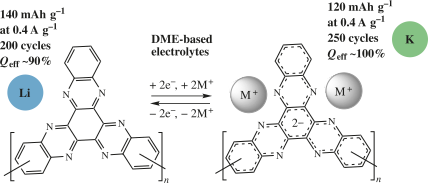
Ключевые слова: poly-HATN, hexaazatrinaphthylene, lithium-ion battery, potassium-ion battery, 1,2-dimethoxyethane, discharge capacity, charge–discharge cycling, quantum chemical modeling.

Поступила в редакцию: 06.03.2025
Принята в печать: 05.05.2025

Язык публикации: английский

DOI: 10.71267/mencom.7759


Реферативные базы данных:


© МИАН, 2026