RUS  ENG
Полная версия
ЖУРНАЛЫ // Mendeleev Communications // Архив

Mendeleev Commun., 2025, том 35, выпуск 6, страницы 699–701 (Mi mendc7329)

Communications

119Sn Mössbauer spectroscopy of nickel zinc orthostannates prepared by self-propagating high-temperature synthesis

M. V. Kuznetsova, D. A. Pankratovbc, Yu. G. Morozovd, A. V. Safonova, O. V. Belousovad

a All-Russian Research Institute on Problems of Civil Defence and Emergencies, 121352 Moscow, Russian Federation
b Department of Chemistry, M. V. Lomonosov Moscow State University, 119991 Moscow, Russian Federation
c Moscow Institute of Physics and Technology (National Research University), 141700 Dolgoprudny, Moscow Region, Russian Federation
d A. G. Merzhanov Institute of Structural Macrokinetics and Materials Science, Russian Academy of Sciences, 142432 Chernogolovka, Moscow Region, Russian Federation


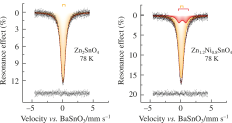
Аннотация: Zinc orthostannate (Zn2SnO4) and nickel zinc orthostannate (Zn1.2Ni0.8SnO4) were prepared by self-propagating hightemperature synthesis (SHS) and characterized by 119Sn Mössbauer spectroscopy. Both orthostannates are cubic spinels exhibiting defect-induced ferromagnetic behavior due to their microstructures. The Mössbauer spectrum of Zn2SnO4 appears as single unresolved doublet [δ = 0.169(3) mm s–1, Δ = 0.45(1) mm s–1], and in the case of Zn1.2Ni0.8SnO4, partial substitution of zinc by nickel is the cause of the appearance of a second doublet of Sn4+ [δ = 0.44(9) mm s–1, Δ = 1.62(1) mm s–1] due to an increase in the occupancy of the 5s orbital of the corresponding tin atoms and the localization of crystallographic defects near them.

Ключевые слова: self-propagating high-temperature synthesis, SHS, nickel zinc orthostannates, microstructure, X-ray diffraction, Mössbauer spectra, XPS, magnetic measurements.

Поступила в редакцию: 18.04.2025
Принята в печать: 11.06.2025

Язык публикации: английский

DOI: 10.71267/mencom.7804


Реферативные базы данных:


© МИАН, 2026