RUS  ENG
Полная версия
ЖУРНАЛЫ // Mendeleev Communications // Архив

Mendeleev Commun., 2025, том 35, выпуск 6, страницы 746–748 (Mi mendc7324)

Communications

The role of diglyme and tetraglyme in the formation of ion transport pathways in gel electrolytes based on polyethylene glycol diacrylate

N. A. Slesarenkoa, A. V. Chernyakab, V. I. Volkova, K. G. Khatmullinaac, A. V. Yudinaa, G. Z. Tulibaevaa, A. A. Slesarenkoa, G. R. Baymuratovaa, A. F. Shestakovad, O. V. Yarmolenkoa

a Federal Research Center of Problems of Chemical Physics and Medicinal Chemistry, Russian Academy of Sciences, 142432 Chernogolovka, Moscow Region, Russian Federation
b Yu. A. Osipyan Institute of Solid State Physics, Russian Academy of Sciences, 142432 Chernogolovka, Moscow Region, Russian Federation
c National Research University ‘Moscow Power Engineering Institute’, 111250 Moscow, Russian Federation
d Department of Fundamental Physical and Chemical Engineering, M. V. Lomonosov Moscow State University, 119991 Moscow, Russian Federation


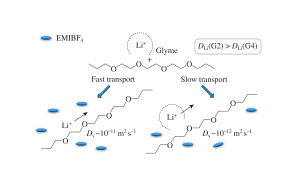
Аннотация: The methods of 7Li spin relaxation and pulsed field gradient NMR were used to reveal the features of local transport of Li+ cations in two polymer gel electrolytes containing an ionic liquid, the salt LiBF4 and a solvent, diglyme (G2) or tetraglyme (G4). It was found that the macroscopic mass transfer of Li+ cations is affected by their solvate environment from both glyme solvents and the polymer matrix. In the presence of G4, a denser three-dimensional network is formed, hindering the transport of all ions.

Ключевые слова: 7Li spin relaxation, PFG NMR, LiBF4, diglyme, tetraglyme, electrochemical impedance, lithium anode, conductivity, diffusion coefficient.

Поступила в редакцию: 04.04.2025
Принята в печать: 29.05.2025

Язык публикации: английский

DOI: 10.71267/mencom.7792


Реферативные базы данных:


© МИАН, 2026