RUS  ENG
Полная версия
ЖУРНАЛЫ // Mendeleev Communications // Архив

Mendeleev Commun., 2025, том 35, выпуск 6, страницы 749–751 (Mi mendc7313)

Communications

Polylactic acid-based scaffolds modified by hyaluronic acid

U. V. Khomutovaab, O. A. Laputac, A. G. Korzhovaa, A. A. Bryuzginaa, Y. G. Shapovalovaa, Yu. Y. Akhmadeevb, V. V. Shugurovb, I. A. Kurzinaac

a National Research Tomsk State University, 634050 Tomsk, Russian Federation
b Institute of High Current Electronics, Siberian Branch of the Russian Academy of Sciences, 634055 Tomsk, Russian Federation
c Surgut State University, 628400 Surgut, Russian Federation


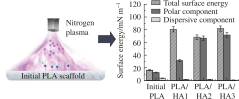
Аннотация: The effect of two-stage surface modification of polylactic acid (PLA)-based scaffolds, including treatment with a low-temperature nitrogen plasma arc discharge and subsequent immobilization of biologically active molecules of hyaluronic acid, on their physicochemical and biological properties was investigated. It was found that the modification changes the chemical composition of the PLA surface, which contributes to an increase in surface energy and a decrease in the water contact angle. Modification of the PLA surface not only does not lead to the appearance of cytotoxic properties, but, on the contrary, helps to maintain the viability of immune cells on its surface.

Ключевые слова: nonwoven fibrous materials, polylactic acid, electrospinning, low-temperature plasma, hyaluronic acid, surface properties, macrophages.

Поступила в редакцию: 11.03.2025
Принята в печать: 03.07.2025

Язык публикации: английский

DOI: 10.71267/mencom.7761


Реферативные базы данных:


© МИАН, 2026