RUS  ENG
Полная версия
ЖУРНАЛЫ // Mendeleev Communications // Архив

Mendeleev Commun., 2025, том 35, выпуск 4, страницы 413–416 (Mi mendc7262)

Эта публикация цитируется в 1 статье

Communications

Carbazole-based conjugated polymers with enhanced UV hardness: promising electron donor materials for stable organic solar cells

E. A. Komissarovaa, S. A. Kuklinab, P. M. Kuznetsova, A. N. Galiullinb, N. A. Slesarenkoa, P. A. Troshinca

a Federal Research Center of Problems of Chemical Physics and Medicinal Chemistry, Russian Academy of Sciences, 142432 Chernogolovka, Moscow Region, Russian Federation
b A. N. Nesmeyanov Institute of Organoelement Compounds, Russian Academy of Sciences, 119334 Moscow, Russian Federation
c Zhengzhou Research Institute, Harbin Institute of Technology, 450003 Zhengzhou, China


Аннотация: Guided by the previously discovered relationships between the molecular structure of the conjugated polymers and their photostability, herein, we have successfully designed and synthesized new conjugated polymers incorporating thiophene, 2,1,3-benzotriazole and carbazole units employing the Stille coupling. The polymers exhibited record-high stability under UV light exposure, outperforming a well-known and fairly stable benchmark material, PCDTBT. The presented novel materials can be promising electron-donor components for the new generation of organic solar cells fitting the ‘golden triangle’, i.e., showing high efficiency, long operational lifetimes, and low cost of the used raw materials.

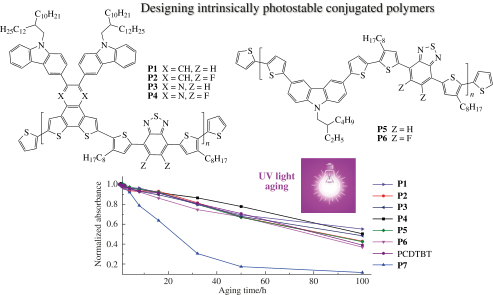
Ключевые слова: conjugated polymers, organic solar cells, photostability, operational stability, UV light hardness, Stille reaction, carbazole.

Поступила в редакцию: 12.12.2024
Принята в печать: 25.02.2025

Язык публикации: английский

DOI: 10.71267/mencom.7708


Реферативные базы данных:


© МИАН, 2026