RUS  ENG
Полная версия
ЖУРНАЛЫ // Mendeleev Communications // Архив

Mendeleev Commun., 2025, том 35, выпуск 3, страницы 327–330 (Mi mendc7009)

Эта публикация цитируется в 1 статье

Communications

Impact of fluorination on optoelectronic properties of thiophene-benzothiadiazole-based hole-transport polymers for perovskite solar cells

E. A. Komissarovaa, S. A. Kuklinab, N. A. Slesarenkoa, A. F. Latypovaa, A. F. Akbulatova, V. V. Ozerovaa, M. N. Kevrevaa, N. A. Emelianova, L. A. Frolovaa, P. A. Troshinac

a Federal Research Center of Problems of Chemical Physics and Medicinal Chemistry, Russian Academy of Sciences, 142432 Chernogolovka, Moscow Region, Russian Federation
b A. N. Nesmeyanov Institute of Organoelement Compounds, Russian Academy of Sciences, 119334 Moscow, Russian Federation
c Zhengzhou Research Institute of HIT, Jinshui District, 450003 Zhengzhou, China


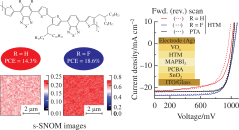
Аннотация: Novel polymers composed of thiophene units combined with non-fluorinated and fluorinated 2,1,3-benzothiadiazole units were synthesized and investigated as hole transport materials in perovskite solar cells. The impact of backbone fluorination on the optical and electronic properties of the resulting materials as well as the nanoscale morphology of their films deposited on the perovskite absorber layer was elucidated. The fluorinated polymer provided a superior power conversion efficiency of 18.6% coupled with high open-circuit voltage (VOC = 1.047 V) and short-circuit current (JSC = 23.4 mA cm−2).

Ключевые слова: thiophene, 2,1,3-benzothiadiazole, Stille cross-coupling, IR s-SNOM, hole transport materials, perovskite solar cells, PSCs.

Поступила в редакцию: 30.09.2024
Принята в печать: 13.01.2025

Язык публикации: английский

DOI: 10.71267/mencom.7632


Реферативные базы данных:


© МИАН, 2026