RUS  ENG
Полная версия
ЖУРНАЛЫ // Mendeleev Communications // Архив

Mendeleev Commun., 2014, том 24, выпуск 6, страницы 340–341 (Mi mendc2573)

Эта публикация цитируется в 3 статьях

Communications

Computational study of the catalytic olefination reaction

I. D. Gridneva, A. V. Shastinb, V. M. Muzalevskiyc, E. S. Balenkovac, V. G. Nenajdenkocd

a Department of Chemistry, Graduate School of Science, Tohoku University, Sendai, Japan
b Institute of Problems of Chemical Physics, Russian Academy of Sciences, Chernogolovka, Moscow Region, Russian Federation
c Department of Chemistry, M.V. Lomonosov Moscow State University, Moscow, Russian Federation
d A.N. Nesmeyanov Institute of Organoelement Compounds of Russian Academy of Sciences, Moscow, Russian Federation


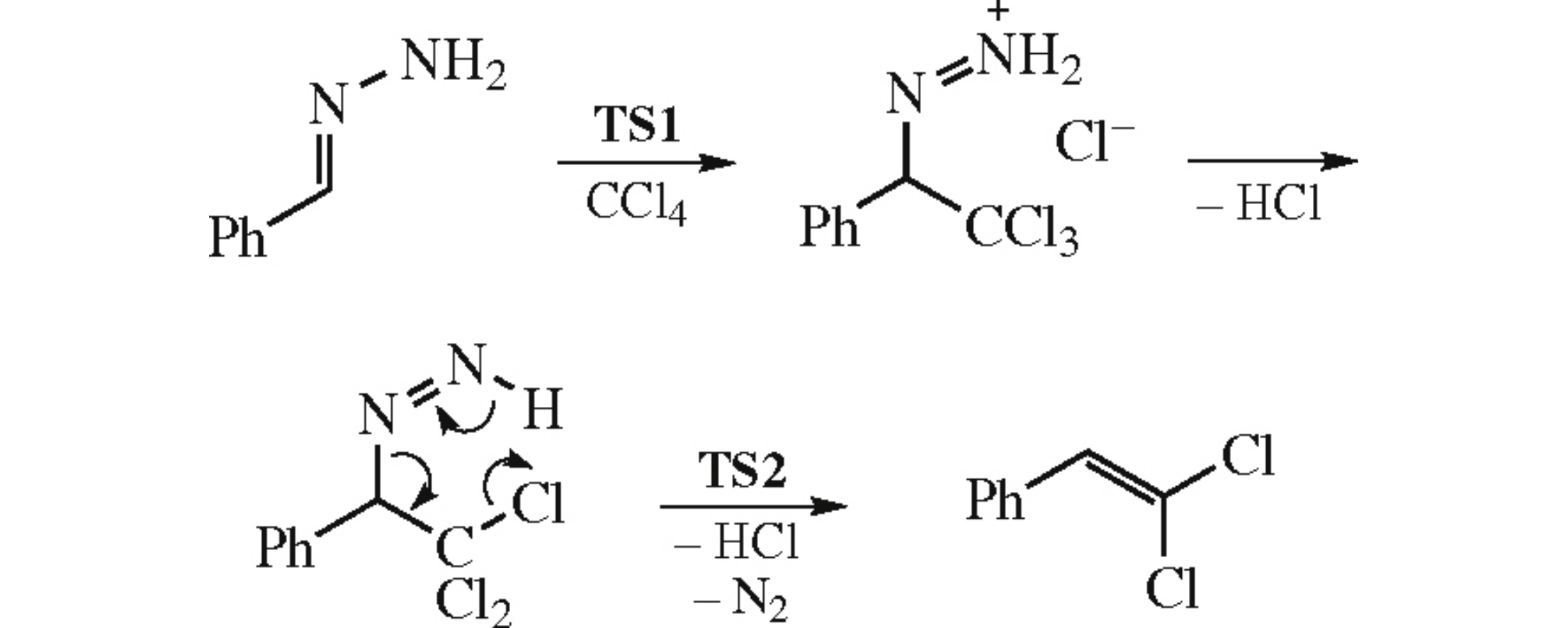
Аннотация: Catalytic olefination of hydrazones was computed to proceed with effective activation barrier of 19.9kcal mol–1. Initially the catalyst- assisted abstraction of Cl anion from CCl4 occurs that is accompanied by simultaneous C–C bond formation; then proton is eliminated by ammonia present in the reaction mixture yielding a neutral intermediate; the second CuCl-assisted abstraction of Cl anion from CCl3 group is followed by synchronous reaction that affords the olefination product and releases N2 together with CuCl.HCl.

Язык публикации: английский

DOI: 10.1016/j.mencom.2014.11.008


Реферативные базы данных:


© МИАН, 2026